Blog
>
Chillon Collections ...
26 June 2026
Chillon Collections #2 Weapons and Armour
Chillon Castle is an exceptional heritage monument, with around 300 items on display throughout. With the exception of the furniture, weapons and armour, all of the items exhibited here were found during the archaeological digs carried out at the castle from 1896 to 1903. The collections belong to the Cantonal Museum of Archaeology & History of Lausanne under the name ‘fonds Chillon’.
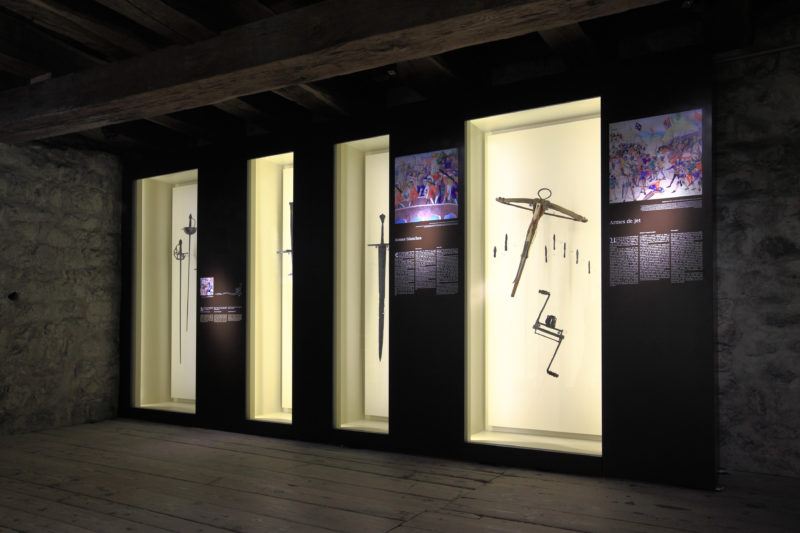
Chillon Castle has three weapons rooms spread throughout the defensive part of the building.
Two floors of the dungeon are reserved for weapons from the Middle Ages to the 17th century – swords, masses, arquebuses and halberds.
The defence tower houses three suits of armour, including chain mail.
When archaeologist and art historian Aloys de Molin (1861-1914) became the castle curator in 1893, he set about purchasing a series of items to furnish the castle. He acquired valuable pieces at auction, such as statues and leaded windows, but also weapons and armour. In doing so, he built one of the main axes for the future museum imagined for Chillon.
Twenty years later, Albert Naef (1862-1936), castle architect and the first archaeologist for the canton of Vaud, boosted the quality of the collection by intervening during Eugène Aunant’s bequest. The weapons were then distributed between the Cantonal Museum of Archaeology and History in Lausanne and Chillon Castle. Naef favoured quality and authenticity over quantity: he most notably recovered a German double-handed sword, dating from 1536, and a 17th-century harquebus made in a workshop in Lucerne. Subsequently, he invested more and more money in acquiring weaponry for the rest of the castle.
The collections were still mostly added to by means of donations, deposits and bequests. Almost all the halberds exhibited come from Charles Marcel’s depot, which the Association for the Restoration of Chillon Castle took over in 1970. More recently, in 2004, the Bron donation helped the castle acquire a 19th-century copy of a 16th-century German suit of plate-armour.
LOCATION
Bastion, room n°35
Keep, room n°42
Sous la direction de Lionel PERNET, Révéler les invisibles : Collections du Musée cantonal d’archéologie et d’histoire de Lausanne. 1852-2015, Gollion : Infolio Editions, 2017.Nicolas P. BAPTISTE, Armatus corpus : Princes et chevalier (1330-1530). 600 ans du duché de Savoie, Gollion : Infolio Editions, 2016
Crossbow and arrowheads
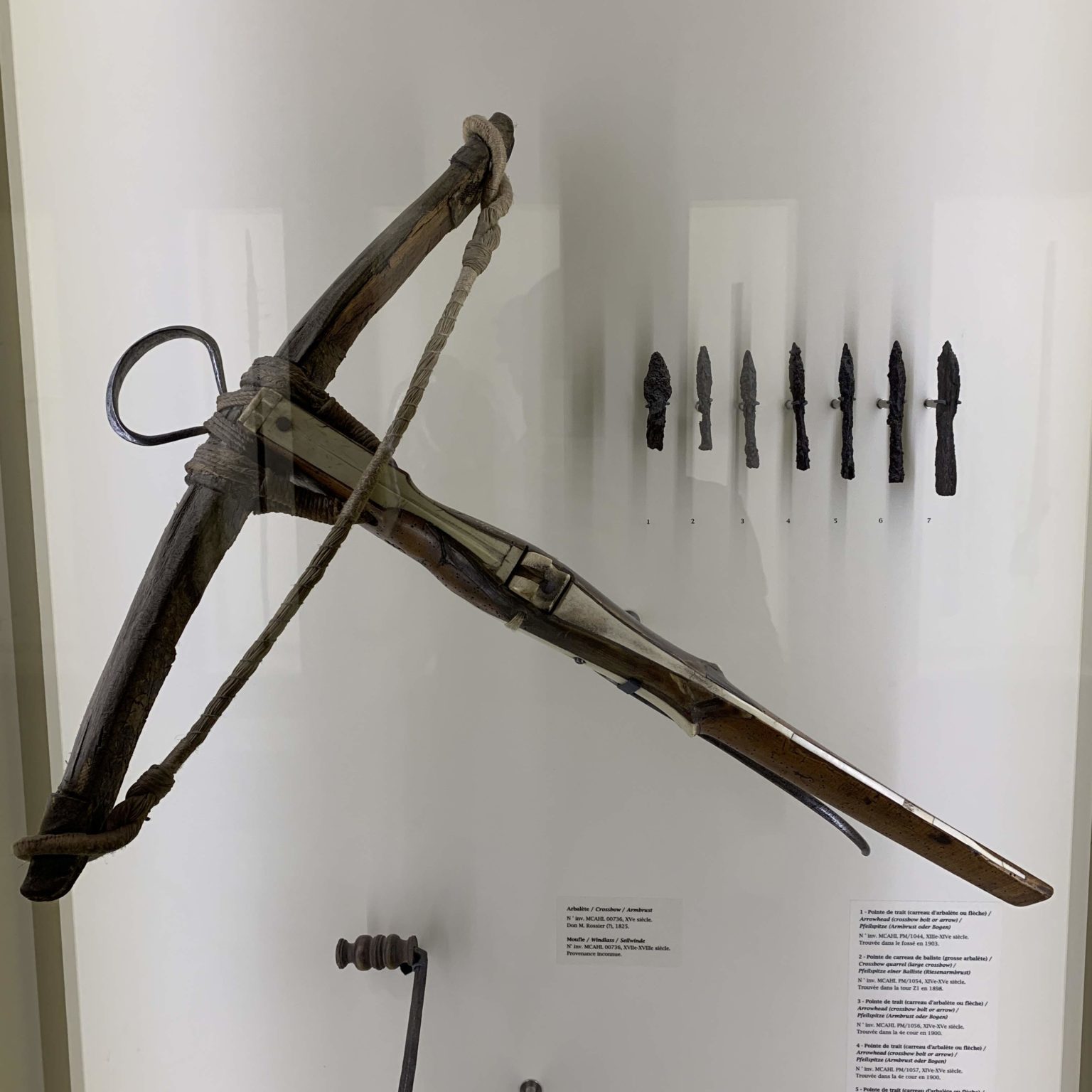
Located on the second floor of the keep, Chillon Castle’s permanent exhibition of old weapons includes a crossbow and a series of arrowheads dating from the medieval period, as well as a jack called a ‘windlass’ to reload the bolts.
In Switzerland, the first crossbow appeared on the seal of Councillor Johann von Hildisrieden of Lucerne in 1235. Although the weapon was slow, it was precise, powerful (crossbows shoot arrows at more than 300 kilometers per hour) and easy to handle. This made it an extremely deadly object. The Church forbade its use, but European sovereigns ignored this.
The model on display in Chillon – a donation made by a private individual in 1825 – dates from the 15th century. It is made of fruit wood with inlays of deer antlers and horn. Originally, the bow at the front of the weapon was covered with painted birch bark. Its range is estimated at 150 metres, outstripping the usual 70-90. At the time of manufacture, crossbows became so stiff that they needed jacks to cock them, such as the windlass on display in the exhibition window (17th century). Once firearms began to emerge, crossbows were mainly reserved for hunting. Eventually, in the 19th century, they became sports weapons.
All of these crossbows were found at the castle during archaeological excavations carried out at the turn of the 20th century. The various arrowheads on display date from the 13th to 15th centuries. They can be tightened and lengthened, making it possible to appreciate the sheer size of the projectiles.
LOCATION
Second floor of the keep, room n°46
Arbalète
15e siècle
Bois, bois de cerf, corne
Musée cantonal d’archéologie et d’histoire, Lausanne
MCAHL 00736
Don de M. Rossier ( ?), 1825
Moufle
17-18e siècle
Musée cantonal d’archéologie et d’histoire, Lausanne
MCAHL 00736
Provenance inconnue
Pointe de trait (carreau d’arbalète ou flèche)
13-14e siècle
Métal non spécifié
Musée cantonal d’archéologie et d’histoire, Lausanne
PM/1044
Trouvée dans le fossé en 1903
Pointe de carreau de baliste (grosse arbalète)
14-15e siècle
Métal non spécifié
Musée cantonal d’archéologie et d’histoire, Lausanne
PM/1054
Trouvée dans la tour Z1 en 1898
Pointe de trait (carreau d’arbalète ou flèche)
14-15e siècle
Métal non spécifié
Musée cantonal d’archéologie et d’histoire, Lausanne
PM/1056
Trouvée dans la 4e cour en 1900
Pointe de trait (carreau d’arbalète ou flèche)
14-15e siècle
Métal non spécifié
Musée cantonal d’archéologie et d’histoire, Lausanne
PM/1057
Trouvée dans la 4e cour en 1900
Pointe de trait (carreau d’arbalète ou flèche)
14-15e siècle
Métal non spécifié
Musée cantonal d’archéologie et d’histoire, Lausanne
PM/1058
Trouvée dans la 4e cour en 1900
Pointe de trait (carreau d’arbalète ou flèche)
14-15e siècle
Métal non spécifié
Musée cantonal d’archéologie et d’histoire, Lausanne
PM/1059
Trouvée dans la 4e cour en 1900
Pointe de trait (carreau d’arbalète ou flèche)
14-15e siècle
Métal non spécifié
Musée cantonal d’archéologie et d’histoire, Lausanne
PM/1060
Trouvée dans la 4e cour en 1900
Matchlock arquebus
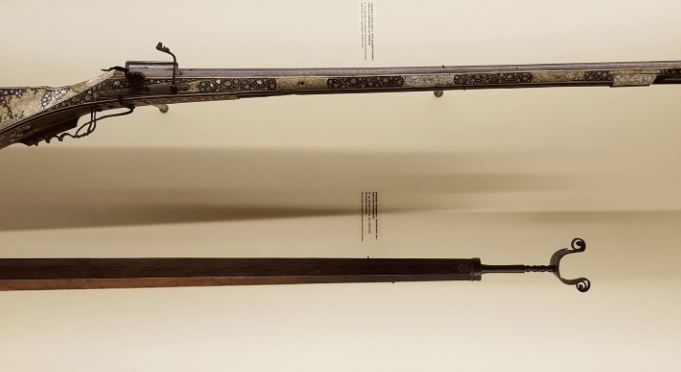
This arquebus, which came to Chillon Castle in July 1913, is part of a set of thirty items bequeathed by Doctor Eugène Aunant of Lausanne. The batch was probably distributed between two institutions the castle and the Vieux-Lausanne Association by local archaeologist Albert Naef. Most of these weapons and armour are now kept in the Cantonal Museum of Archaeology and History, with the exception of this arquebus and a 15th-century chainmail, exhibited at Chillon.
On its octagonal barrel, the arquebus bears the hallmark of the town of Lucerne and that of the Lucerne-based gunsmith, Hans Horwer. The latter is mentioned in sources from 1605 to 1602. Consequently, this gun can be dated back to 1600-1620.
It was probably used in shooting ranges and for hunting deer. The rifled barrel enabled extremely accurate shots. It is testament to a type of firearm that emerged at the beginning of the 15th century, which was heavy, difficult to handle, and had to be supported by a forked rest.
Arquebuses quickly became a pretext for rich decoration and true regalia. This item is a clear example of this, with its luxuriously decorated grip and barrel, encrusted with engraved gold and mother-of-pearl. The barrel is adorned with floral, rinceau, and feather motifs, along with animals, genre art and landscapes.
The grip, on the other hand, depicts a famous story from Greek mythology, The Judgement of Paris. At the far end, the goddesses Aphrodite, Hera and Athena have been brought together by the god Hermes, who features in the centre with his emblem, the caduceus. At the top of the handle, Paris, dressed in 15th century clothing, is sat on a throne flanked by his horse and dogs. He is preparing to offer Aphrodite, the goddess of love, the prized apple for the most beautiful goddess.
This arquebus is one of the most stunning testaments to this style of 15th century weapon in all of Switzerland.
LOCATION
Second floor of the keep, room n°46
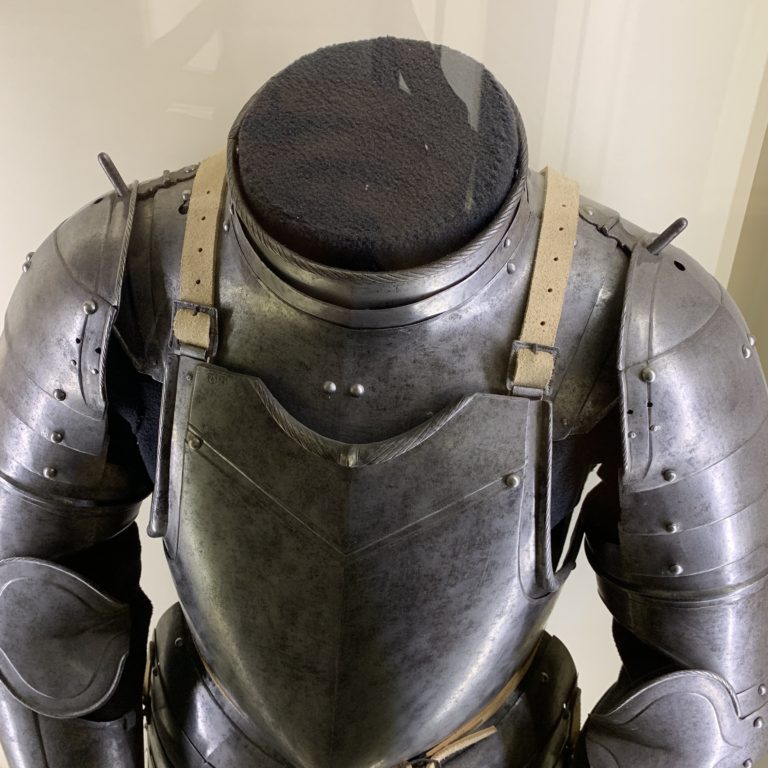
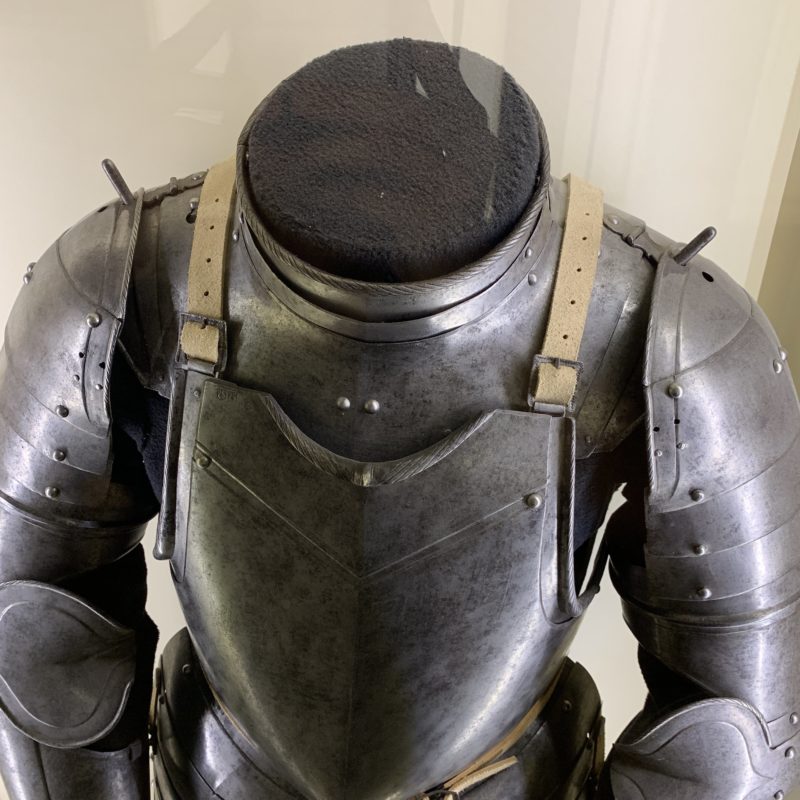
Iron half suit of armour
Through stylistic cross-checking with other contemporary examples, this plated suit of armour has been dated back to the 1560s. The top right-hand side of the chest guard bears the hallmark of the Hofmann armourer line. The Hofmanns were of German origin and based in Frauenfeld (Canton of Thurgau) from 1552.
This suit of armour probably came to the Chillon collection in around 1893. That year, the castle curator, Aloys de Molin (1861-1914) attended an auction organised by the antiques dealer, Gubler, in Zürich. Since furniture was exorbitantly priced, he settled for weapons and armour, purchasing around 20 items. This half suit of armour is made up of 12 elements pieced together with leather straps: breastplate and backplate, gorget, arms, gauntlets, segmented tassets (two pieces of plate armour designed to protect the thighs), and finally the codpiece, a fairly rare item used to cover the crotch. The only part missing is the visor, which protected the face.
The year 1592 is engraved in the centre of the breastplate. Since the armour was manufactured prior to this date, it must allude to an important event; it could perhaps be linked to the Frauenfeld Shooting Society, whose members were depicted on a painted wooden panel this exact year.
This armour was extensively restored in 2014. It underwent a polishing and forging treatment to uncover its orginal, so-called ‘white’ colour, which had been altered through corrosion. It had previously been believed to be a black suit of armour.
Demi-armure
Vers 1560
Allemagne ou Suisse
Fer, alliage cuivreux et cuir
MCAHL
inv : 00161
LOCATION
Second floor of the keep, room n°46
Further reading
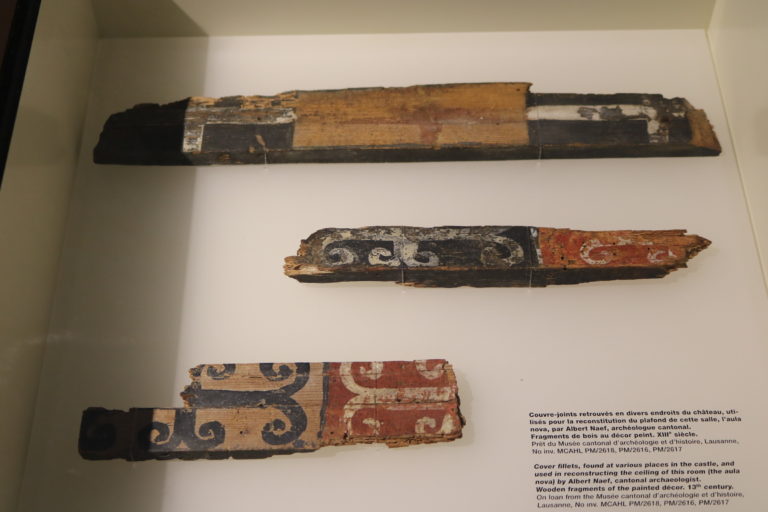
The Chillon Collections #3: Archaeological Artefacts
An exceptional heritage site, Chillon Castle displays nearly three hundred objects along its visitor route. The collections belong to the Cantonal Museum of Archaeology and History in Lausanne and are known as the ‘Chillon collection’. Discover some of these collections in our new series of articles.
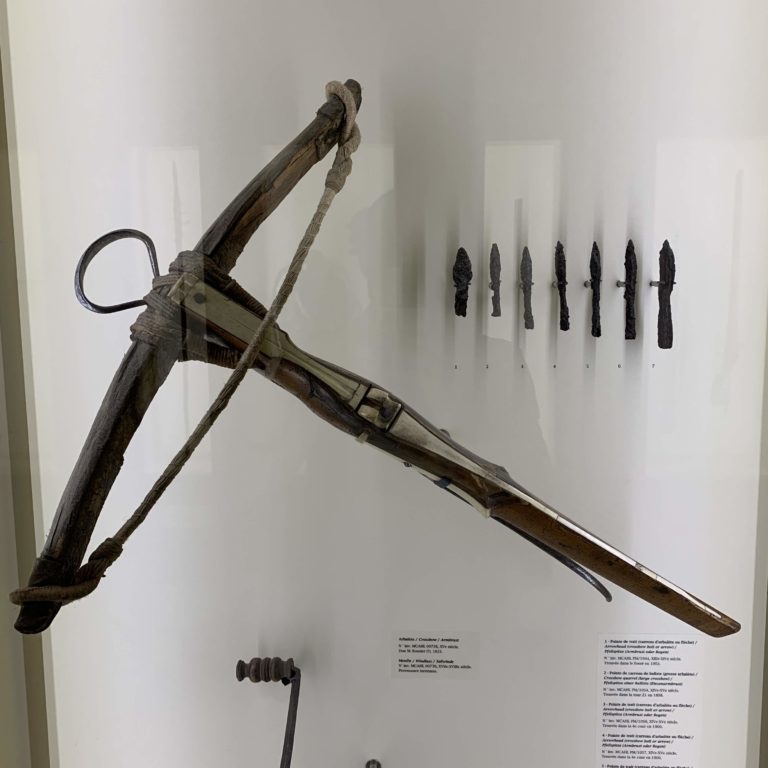
The Chillon crossbows in the spotlight
Housed in the armoury of the keep, this 15th-century crossbow was not discovered on the site, but was donated by a private individual in 1825. This was four years before Gioachino Rossini composed his opera *William Tell*, based on this founding myth of Switzerland.
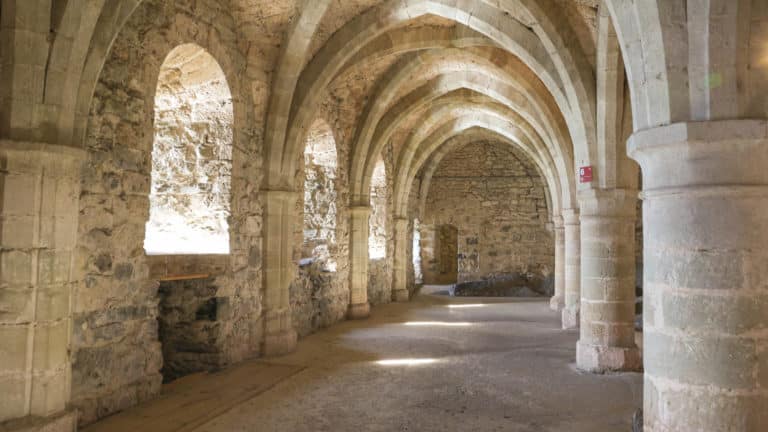
Take on the 10 Chillon challenges
To make the most of your trip while (re)discovering the monument, we’ve set you a (non-exhaustive) list of 10 fun challenges to complete at the castle.