Blog
>
Chillon Collections ...
15 August 2026
Chillon Collections #4 Paintings and murals
Chillon Castle is an exceptional heritage monument, with around 300 items on display throughout. With the exception of the furniture, weapons and armour, all of the items exhibited here were found during the archaeological digs carried out at the castle from 1896 to 1903. The collections belong to the Cantonal Museum of Archaeology & History of Lausanne under the name ‘fonds Chillon’
While you may only see four paintings and etchings throughout the castle tour, Chillon actually has a much richer selection of frescos and murals. Several rooms contain graffiti or charcoal drawings, in the prison, for example, where people have been leaving their mark since the 13th century.
Despite the heavy restoration work carried out in 1914 by painter Ernest Correvon (1842-1923) at the request of the castle architect, Albert Naef, there is one remaining collection of exceptional frescos to be admired in the chapel. In the adjacent main section of the building, the Camera Domini is home to an impressive range of paintings commissioned by Count Aymon of Savoy in the 14th century, combining to form a heraldic frieze topped with a princely menagerie.
Sous la direction de Daniel DE RAEMY, Chillon : la chapelle, Lausanne : Association du Château de Chillon, 1999.
Sous responsabilité de Denis BERTHOLET, Olivier FEIHL et Claire Huguenin, Autour de Chillon : archéologie et restauration au début du siècle, Ecublens : DIP SA, 1998
Map of the Vaudois territory
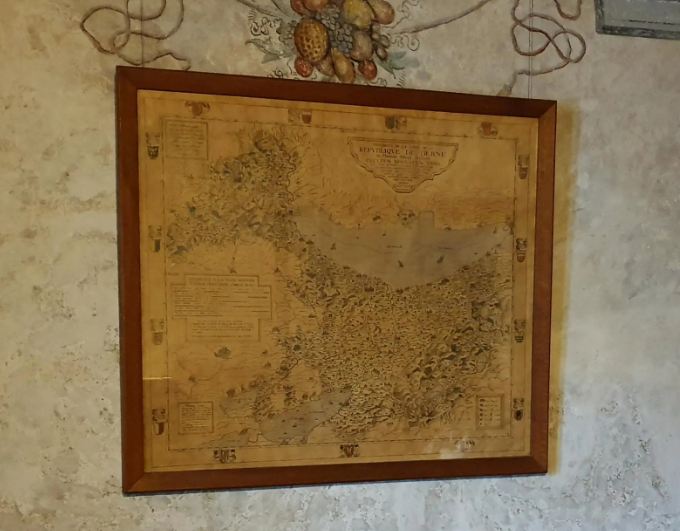
This map is located on the northern wall of the Bernese Bedroom (room 16). It is a relatively accurate depiction of the Vaudois territory in the last quarter of the 16th century, then under the rule of the confederates of the city of Bern.
The original map was drawn by Thomas Schepf. He was a doctor in the city of Bern in 1565 and worked on the description of the territories to which it belonged. This work continued until 1576, when he received permission to publish the results of his observations (his map and an accompanying commentary). Only three copies of this work remain (one in Bern City Library, one in the Military Library of Bern and one in the Historical Museum of Lausanne). The map was published at a time when cartography was booming. The famous cartographer Ortelius mentions Schepf’s map in a list of published documents from which he drew inspiration for his treatise Theatrum Orbis Terrarum, the first modern atlas.
In 1925, F. Dubois, the director of the Historical Museum of Lausanne, presented this map at the Vaud History and Archaeology Society’s general meeting. His speech caught the attention of Mr. Hegg, the director of the land registry. Noting the significance of this document for the history of local cartography, he had a copy of some parts of Schepf’s plan drawn up. This first production made it possible for several heliogravure prints to be produced in 1930, including the one exhibited at Chillon Castle.
LOCATION
Bernese Bedroom, room 16
Carte du Pays de Vaud (facsimilé)
1930
Héliogravure
Musée cantonal d’archéologie et d’histoire (Lausanne)
IC-19
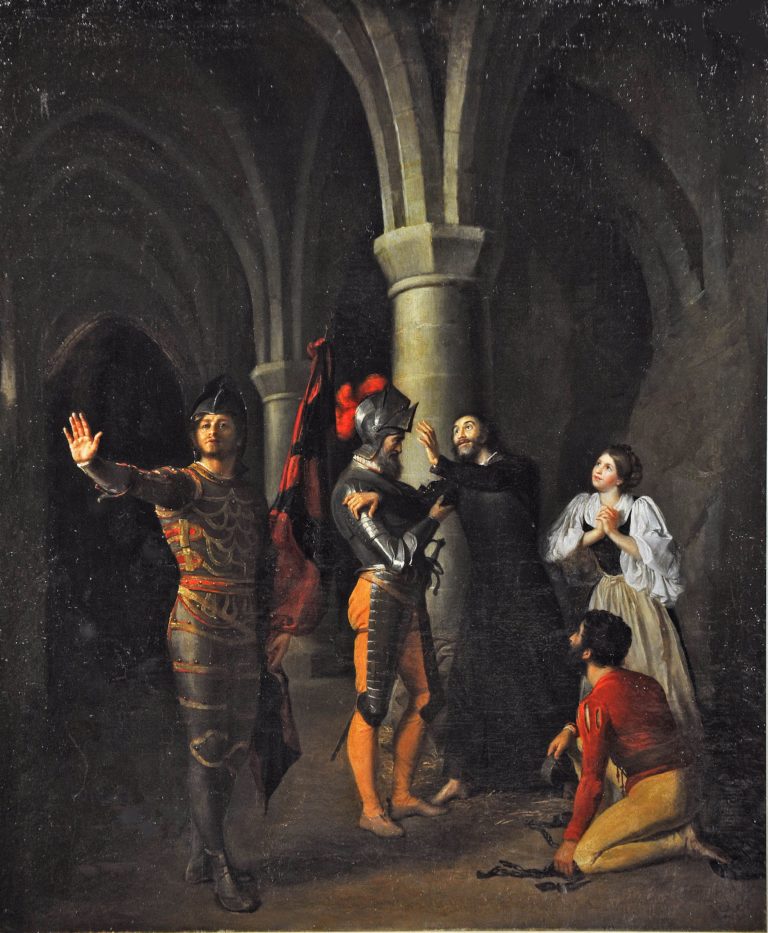
Paintings : François Bonivard’s imprisonment in Chillon Castle
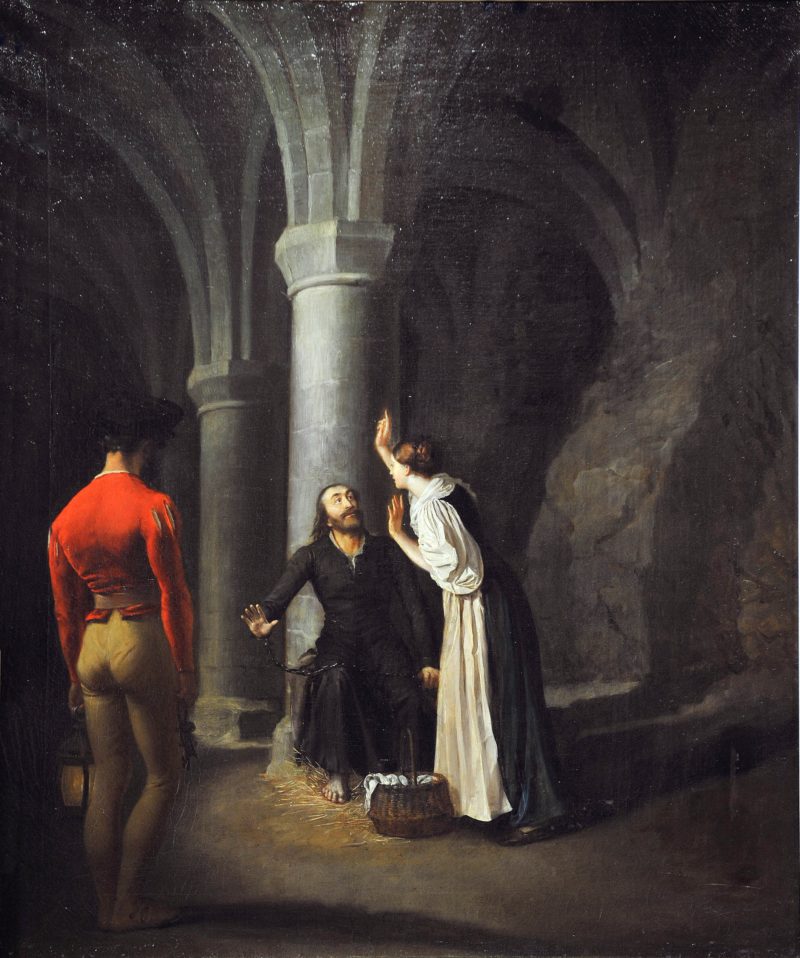
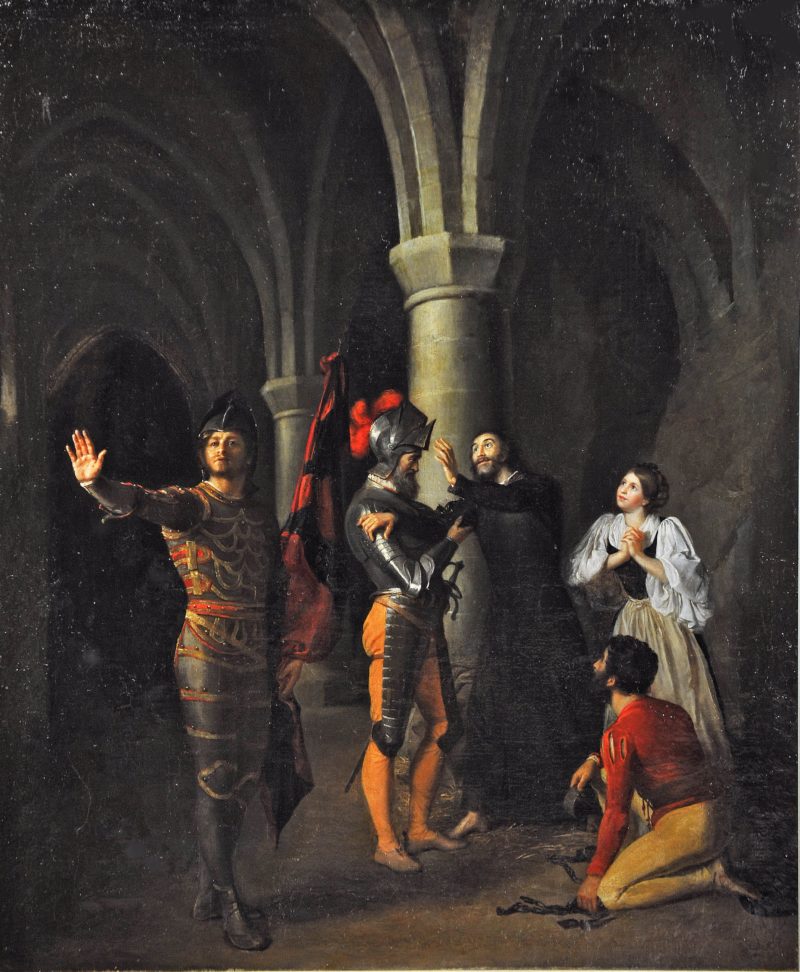
François Bonivard (1493-1570) came from the lower Savoyard nobility and was the prior of Saint-Victor in Geneva from 1514. He quickly joined forces with the party opposed to the Duke of Savoy’s efforts to control the city. This led to his arrest and incarceration in Chillon Castle in 1530. He was freed six years later by the Bernese army when they invaded Vaud. In 1816, poet Lord Byron made Bonivard the romantic hero of his famous poem The Prisoner of Chillon.
Genevan painter Joseph Hornung (1792-1870) was the artist behind the diptych depicting Bonivard in Chillon prison. Self-taught and motivated by a great nostalgia for the 16th century, he is known for his historic paintings with a distinctive preference for themes linked to Savoy and the Protestant Reformation.
The two paintings were fairly unknown to specialists: not even Hornung’s own heirs knew when they were painted, or even that they existed. They can most likely be linked to the history painting competition organised by the Geneva Arts Society in 1824. Here, painters Georges Chaix and Jean-Léonard Lugardon embarked on a ‘clash of the canvases’, each depicting Bonivard’s release by the Bernese army. This major artistic event set Hornung’s name in stone. He would go on to paint his ‘Autoportrait sous les traits de Bonivard‘ (self-portrait depicted as Bonivard) in 1845. The diptych probably dates back to the second quarter of the 19th century.
The first painting depicts the prisoner being consoled by the prison guard’s daughter, while the second illustrates Bonivard being freed by the Bernese. Hornung took particular care to transpose architectural details such as the famous castle prison columns, which leads us to believe he had seen them with his own eyes.
The style of these paintings is similar to that of the Netherlands, most notably in the use of chiaroscuro and the contrasting of bright colours on a dark background. The composition itself evokes the school of French Romanticism from the beginning of the 19th century, with the characters giving hints of very expressive movements.
These paintings were acquired in 2013, thanks to generous support from the Circle of Friends of Chillon. For conservation purposes, they can only be exhibited one at a time over the course of a year in the castle prison.
LOCATION
Prison, room 9
Joseph Hornung
Épisodes de la captivité de François Bonivard à Chillon
1824-1845
Huile sur toile
Paintings on the fireplace in the camera domini
In the mid 14th century, Aymon of Savoy decided to redesign the Camera Domini. At this point, the bedroom of the counts and later dukes of Savoy was redecorated with figurative paintings. In 1587, the Bernese artist Andreas Stoss painted new images on the medieval decor. Restored several times throughout the 20th century, the mantelpiece decoration illustrates the history of these transformations.
The Chillon Castle Camera Domini is located on the first floor of a tower whose origins date back to the 12th century. Between 1336 and 1338, Aymon of Savoy decided to move the fireplace to the north-east corner of the room in order to build a staircase between his bedroom and the chapel. Jean de Grandson decorated the whole room with paintings from 1341 to 1344. Split into three parts, they depict an idyllic garden populated by animals against a blue background. The series of images is crowned by a depiction of Saint George slaying the dragon over the mantelpiece. The image of the patron saint of knighthood almost certainly alludes to the moral and physical qualities of the count himself. This link is reinforced by the presence of the Savoy crosses on the oak frame supporting the cornice. The choice of the fireplace as a prime location to display images of power did not escape the attention of the Bernese conquerors. At the end of the 16th century, the bailiff-governor Hans Wilhelm von Mülinen asked Andreas Stoss to paint a Bernese bear and the date ‘1587’ in the same place.
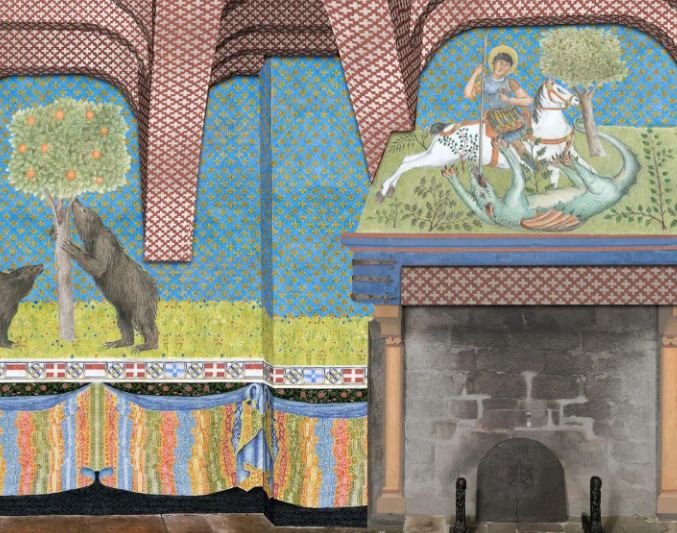
©Fondation du Château de Chillon / © ARCHEOTECH SA
LOCATION
Camera Domini, room 19
Graffiti known as the 'Savoyard Knight'
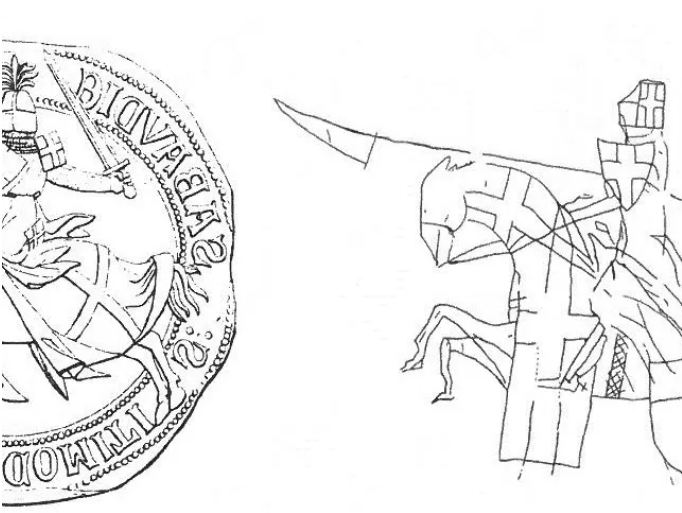
The small drawing room at the heart of the royal apartments (room 20) is home to the castle’s oldest chimney, built in 1336. It also contains an old wall coating, which was mostly covered with medieval graffiti. The ‘Savoyard knight’ design was engraved by a steady hand, at chest height on the southern wall.
The clearly defined graffiti provides a very precise description of the knight, fully clothed in armour, riding a rearing horse. He is wearing a helm, a hauberk covered in chain mail, greaves and sollerets fitted with spurs. He firmly grips a lance in his right hand and a shield covers his left shoulder.
His mount is heavily dressed. The rump cover bears the Savoy coat of arms – a white cross on a red background. The counts, and later dukes, of Savoy were the Lords of Chillon from at least 1150 to 1536.
Stylistic cross-checking dates this graffiti back to the beginning of the 14th century. It is not an original creation, but a pictorial remake of the equestrian seal of Count Amadeus V, Lord of Chillon from 1285 to 1323. Nevertheless, the engraving differs slightly from the original: the horse is no longer galloping but is instead on its hind legs, while the knight, instead of bearing a sword in his left hand, holds a long pike. Hence, what the composition lacks in panache, it makes up for in its stately demeanour, employing balanced shapes.
LOCATION
Petit salon, room 20
Graffiti dit du « chevalier savoyard »
1300-1325
Incision sur enduit
Prison crosses
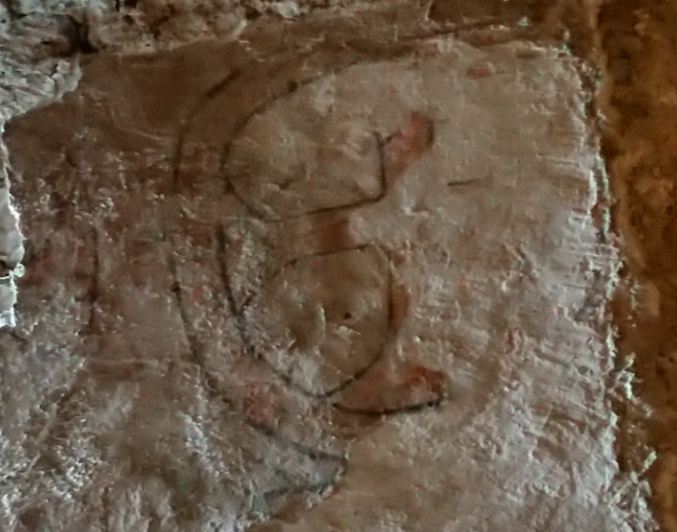
Between 1897 and 1899, while carrying out excavations in the Chillon Castle prison, archaeologist Albert Naef discovered and opened loopholes that had been walled in during the 14th century. On the seventh, he discovered the ‘consecration crosses’. These motifs were painted, engraved or sculpted on the walls, columns or pillars of churches at the time of their ‘dedication’, a ceremony to make them holy and avowed to God.
Naef found in Chillon’s accounts that one of the loopholes had been sealed in 1388. He also dated the crosses back to the 14th century. He linked their presence to one of two events that occurred in the castle during this period. The first was the massacre of the Jews of Villeneuve in 1348, accused of poisoning the fountains right in the middle of a plague epidemic. In Chillon, the populace seized around forty of the imprisoned jews and beat them. They were then taken to the village square and, with no opportunity for a trial, men, women and children were burned on several pyres built on the lakefront. The second was the hunt for a basilisk, a monster feared for its poisonous breath and petrifying abilities, in 1379. Sources mention that they searched the ‘crota’, i.e. a hole or basement in old local dialect, but elaborated no further. The exact location of the crota is not widely accepted by archaeologists. Naef also placed it inside one of the castle’s defence towers on the other side of the site. In both cases, the presence of consecration crosses would symbolise purification of the prison.
LOCATION
Prison, room 9
'Bern-Reich' wall painting
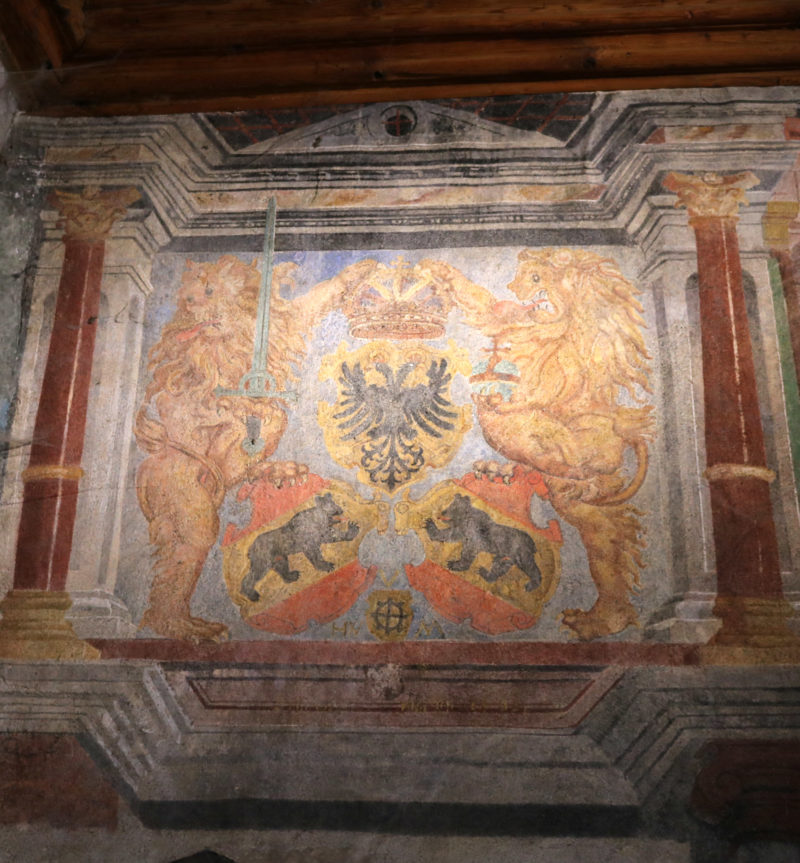
This painting is located above the entrance of the Coat of Arms Hall (room 18). Commissioned by the Bernese bailiff – or governor – Hans Wilhelm von Mühlinen, it expresses the privileges bestowed upon the citizens of Bern from the Holy Roman Empire, to which their city still belonged in the 16th century.
In the painting, two Bernese escutcheons support the two-headed eagle symbolising the Holy Roman Empire. This very specific iconographic composition is named after the Bern Reich, or the ‘Empire of Bern’. The city inherited a particular privilege from the Middle Ages known as ‘imperial immediacy’. Granted by the emperor, it prevented subjects from bowing to other lords and deferring directly to them for taxation and justice.
There is a lion on each side, symbols of the Zähringen family, the founders of Bern. The one on the left holds a sword and the one on the right a globus cruciger, or orb and cross, two symbols of authority. They lift a crown over the imperial eagle as a clear expression of the city’s rights.
Under the Bernese escutcheons are the initials and coat of arms of the Bailiff, Hans Wilhelm von Mühlinen. As the commissioner of this painting in 1586, he wanted to demonstrate his personal prestige and the legitimacy of Bern in the region.
The Confederation was not recognised as being independent from the Holy Empire until 1648, at the end of the Thirty Years’ War. However, Bern continued to paint the Bern Reich until the end of the 17th century.
LOCATION
Coat of Arms Hall, room 18
Andreas Stoss
Peinture murale du Bern Reich
1586
Peinture polychrome
Drawing of the Crucifixion
In 1842, the famous French writer Victor Hugo published a collection of his travel diaries entitled Le Rhin, in which he described a drawing that he observed in the prison of Chillon Castle during his visit in 1839. He attributes it to Michel Cotié, companion of the political prisoner François Bonivard at the beginning of the 16th century: ‘Nothing remains of him [Cotié] but a few charred drawings on the wall. They are half-natured figures that do not lack a certain style; an almost erased Christ on the cross, a Saint on her knees with her legend around her head in Gothic characters, a Saint Christopher […] and a Saint Joseph.’
Dating from the 15th century, this Crucifixion is located on the south wall of the prison, in a small enclosed space called a ‘croton’; the latter served as a chapel for prisoners in the Middle Ages. It has been attested since 1386 in handwritten sources.
In the centre, Christ on the cross is flanked by the Virgin and Saint John. To the right of Mary is Saint Catherine, while John is flanked to his left by Saint Christopher carrying the baby Jesus and Saint Anthony the hermit. They can be identified from the attributes and names written in phylacteries.
In 1899, archaeologist Albert Naef and his team closely examined the various figures represented around Christ on the Cross. They concluded that the drawings were made by different hands – or prisoners – at different times. However, their quality and homogeneity refute this hypothesis: it is inconceivable that captives could have produced these drawings in the dark. On the other hand, art historians have not detected indications of multiple hands or periods. The presence of a Savoy crest, even if it is no longer legible, leads us to believe that this drawing would instead have been the result of a commission from the House of Savoy for those sentenced to death.
Indeed, the presence of the saints is likely down to their consoling powers: Saint Catherine is the patron saint of virgins and the dying, Saint Christopher protector of death without confession, and Saint Anthony protects from the fire of hell.
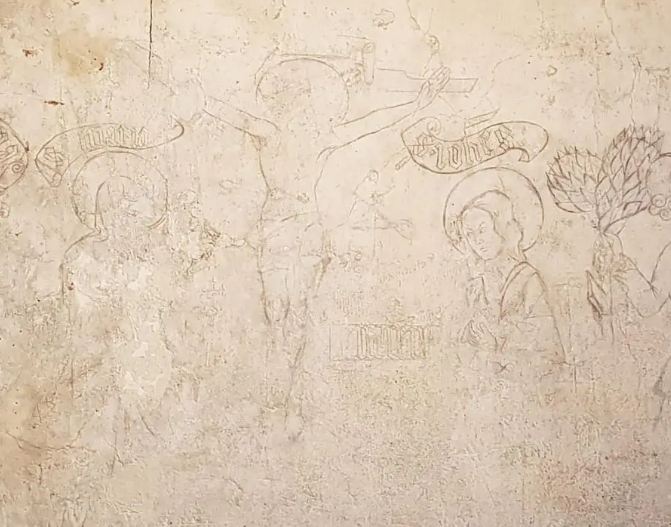
Dessin de la Crucifixion
XVe siècle
Craie grasse noire
LOCATION
Prison, room 9
Paintings on the western wall of the chapel: Judgement Day
During a campaign between 1914 and 1916, archaeologist Albert Naef and painter Ernest Correvon decided to complete the restoration of the chapel paintings on the western wall, whose medieval paintings had been almost completely destroyed. From a meagre original clue, they chose to recreate a painting symbolising Judgement Day.
Dating from the 14th century, the paintings are themed around the figure of Christ.
The frescos on the ceiling depict characters from the Old Testament, from Christ’s earthly lineage or prophets who announced his coming. This set ends with John the Baptist, making the transition to the New Testament. On the eastern wall, wall paintings represent the announcement of Mary’s pregnancy. The northern and southern walls depict the New Testament. They have been heavily repainted.
The western wall is the most damaged. A thin fragment of original painting remains on the left, representing the head of an angel. Reading this chronoligically, Naef and Correvon chose to represent ‘Judgement Day’, the end of time according to Christianity. They copied another painting from the narthex of Romainmôtier Abbey. However, during the 20th century, researchers rejected this hypothesis. They believed the presence of an angel alluded to the Ascension of Christ to heaven, to a Christ in Majesty with a procession of angels symbolising the resurrection, or to a Coronation of the Virgin after she had ascended into heaven. As it stands, the issue still has not been settled.
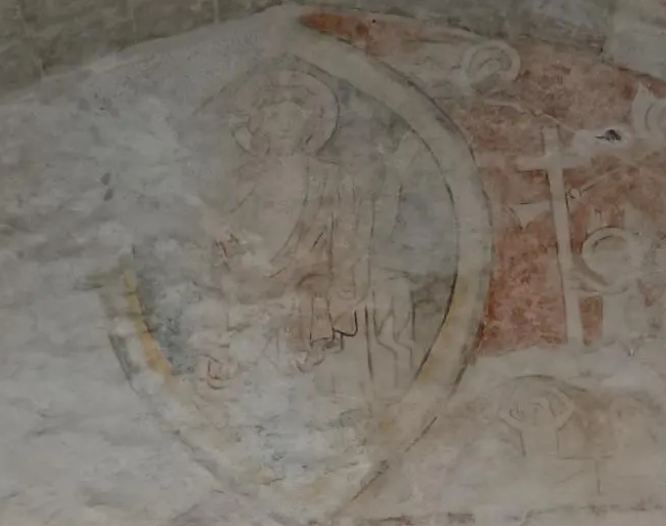
LOCATION
Chapel, room 24
Ernest Correvon
Peintures de la paroi occidentale de la chapelle : le Jugement Dernier
1914-1916
Peinture polychrome
Further reading
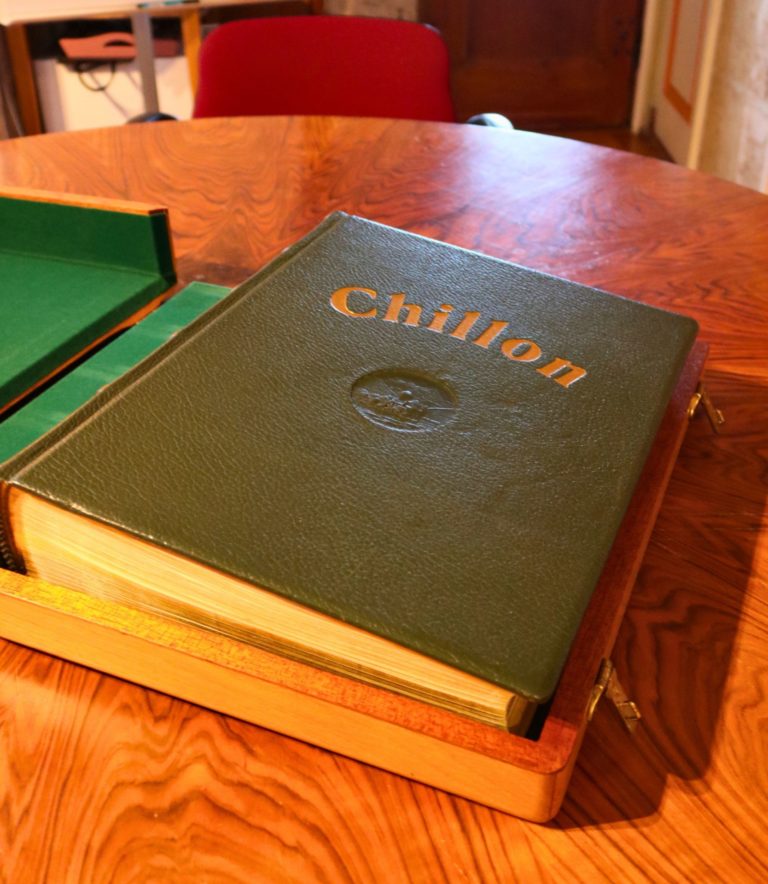
The Chillon Castle guest book
For over 60 years, the castle guest book has kept a record of some of the famous faces who have paid us a visit from the politics, art, sport and media worlds.
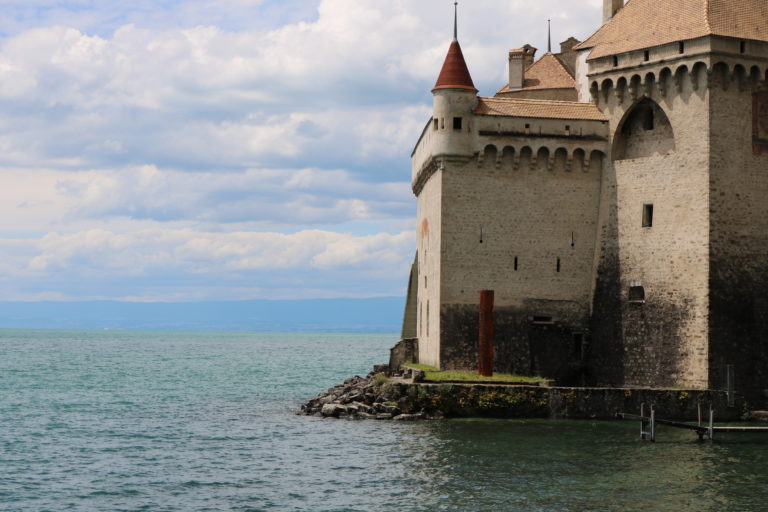
Chillon artists quiz
Chillon Castle is the most visited monument in Switzerland. No doubt, just like many famous artists, you’ve already been. Test your knowledge and find out who really crossed over the drawbridge.
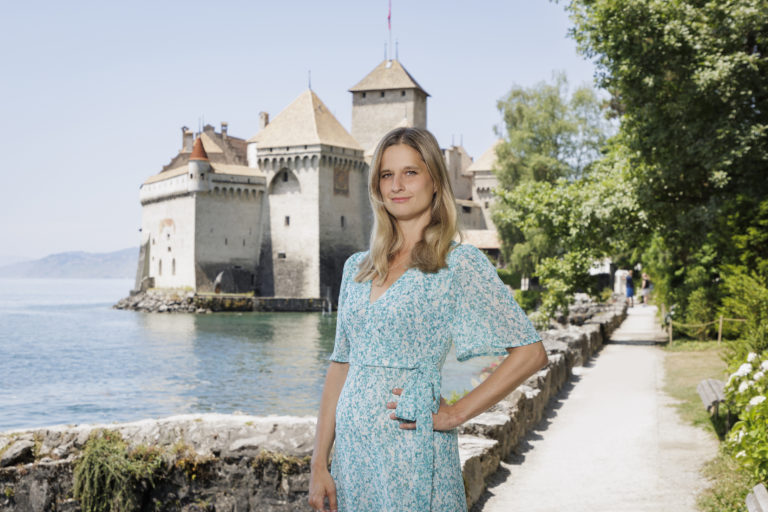
In exhibition workshop « CAROLINE TSCHUMI – ILLUMINATED PRINCESSES »
The Vaud-based artist reveals part of the process behind her 12 portraits of countesses and duchesses of Savoy, as she puts the finishing touches to Béatrice of Portugal. Take a video tour of a glimpse into Caroline Tschumi’s world!